Ai knowledge base chatbot for internal company documents is worth exploring when the objective is concrete: an employee asks which version of a security procedure applies to a current service deployment. Retrieval should return authoritative documents with version and access constraints instead of a plausible unsupported answer.
Start with the actual user
Consider the audience first: IT and operations teams organizing scattered procedures. In this situation, the goal is not simply to keep someone chatting. The experience should help the person understand information, complete a useful task or make an informed next choice. Support and onboarding agents are best treated as controlled interfaces to approved knowledge and limited tools. Success requires a precise scope, fresh policies and a handoff when users need staff judgment.
Source-linked knowledge makes troubleshooting reproducible. Logging unanswered questions can expose documentation gaps without requiring the system to copy entire private conversations. For ai knowledge base chatbot for internal company documents, this changes the design from an open-ended demo into a repeatable workflow with a visible result.
Decisions, tradeoffs and a realistic example
An employee asks which version of a security procedure applies to a current service deployment. In a working product, write down what the system knows, which details it must ask the user to confirm, and what it cannot responsibly infer. Retrieval should return authoritative documents with version and access constraints instead of a plausible unsupported answer.
There are at least two valid implementation levels. An informational assistant can explain approved material and direct someone to the next resource. An action-taking agent needs explicit tool permissions, stronger identity checks when appropriate, transactional confirmation and an audit trail. Choose the simpler level unless the task truly requires the added complexity.
Use retrieval that respects document-level authorization. Pair that choice with a clear correction or cancellation path; a useful conversational experience should remain understandable when the automated step does not work.
Map the workflow before choosing software
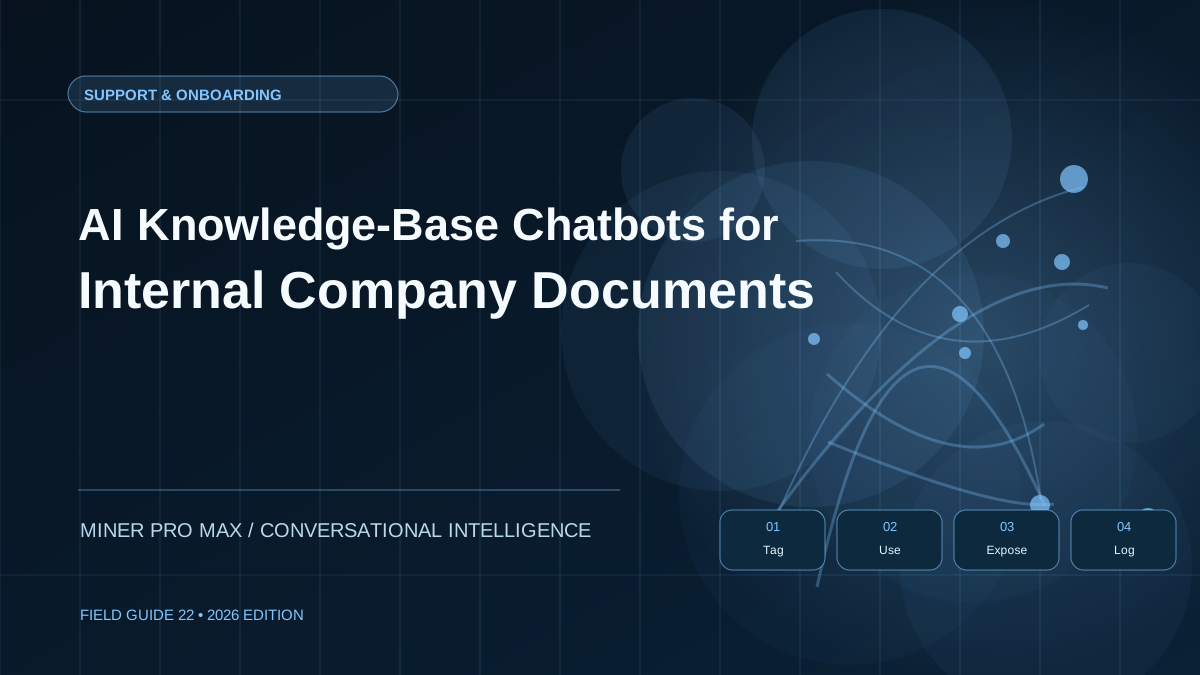
The practical starting point is to translate the scenario into four observable stages. Every stage should be testable independently: someone can verify its input, see its output and decide what happens next. Design the first successful task before building a broad chatbot. The user should be able to inspect an answer, fix mistakes and reach a person.
Tag source documents by owner, date and permissions.
Use retrieval that respects document-level authorization.
Expose source links with each answer.
Log unresolved questions for document owners.
Test the sequence against an unscripted request from the intended audience, then repeat it with missing information and an interrupted session. This reveals whether the agent can admit uncertainty, recover the workflow and still offer a sensible next action. If the answer would have real-world consequences, require an authorized person to approve the action.
Control the exceptions
A pilot should be judged by source-backed answer rate and stale-content incidents, not by how human the answer sounds. Collect a baseline where possible, evaluate a controlled set of common and difficult examples, and have someone review what happened when the AI made a mistake. Keep evaluation data proportionate and access-controlled.
A smooth transition to a support professional is part of the product, not an admission of failure. Preserve the issue summary and avoid asking the customer to repeat everything. Because conversational AI can produce confident errors, important facts, transactions and commitments should be independently confirmed.
From research to a responsible first version
For IT and operations teams organizing scattered procedures, the most useful first release solves one specific problem end to end. Begin with the concrete first step: tag source documents by owner, date and permissions, choose a safe feedback channel and publish what the agent is allowed to do. Then expand only when the measured results justify additional permissions, storage or cost.
Visitors exploring the ecosystem can discover the character-led AI experience at AskValora.com or compare the separate VELUXE AI hub. These links are starting points for exploring current products—not assurances that every workflow described in this educational guide is already deployed. For hardware planning, Miner Pro Max illustrates the kinds of systems to evaluate for local or dedicated AI workloads.
Use these independent technical and governance resources alongside vendor documentation: OWASP LLM Application Risks · W3C Web Accessibility Guidelines. They do not certify a particular product or implementation.
Questions readers ask
What is a practical first step for ai knowledge base chatbot for internal company documents?
Begin with a small, reversible test for IT and operations teams organizing scattered procedures. Tag source documents by owner, date and permissions. Then confirm the experience works for the real user, not only in a scripted demonstration.
How should success be measured for ai knowledge base chatbot for internal company documents?
Use source-backed answer rate and stale-content incidents, alongside direct user feedback and a review of incorrect or unresolved interactions. Establish the baseline before introducing automation.
What is the main limitation to plan for?
Misconfigured retrieval can expose private company information across roles.
Editorial note: scenarios and recommendations are educational examples, not measured deployment results or claims of currently available product integrations. Confirm vendor terms, product capabilities, privacy obligations and technical performance independently.